
Skip to content
HN Pool ConstructionJacksonville, FL

Pool Decks & Pavers

Pool Decks and Pavers in Jacksonville

Travertine, pavers, and concrete decks sloped to drain, sealed for the sun, and matched to your coping and cage.

Mon-Fri 8am-9pm, Sat-Sun closed. We answer the phone.

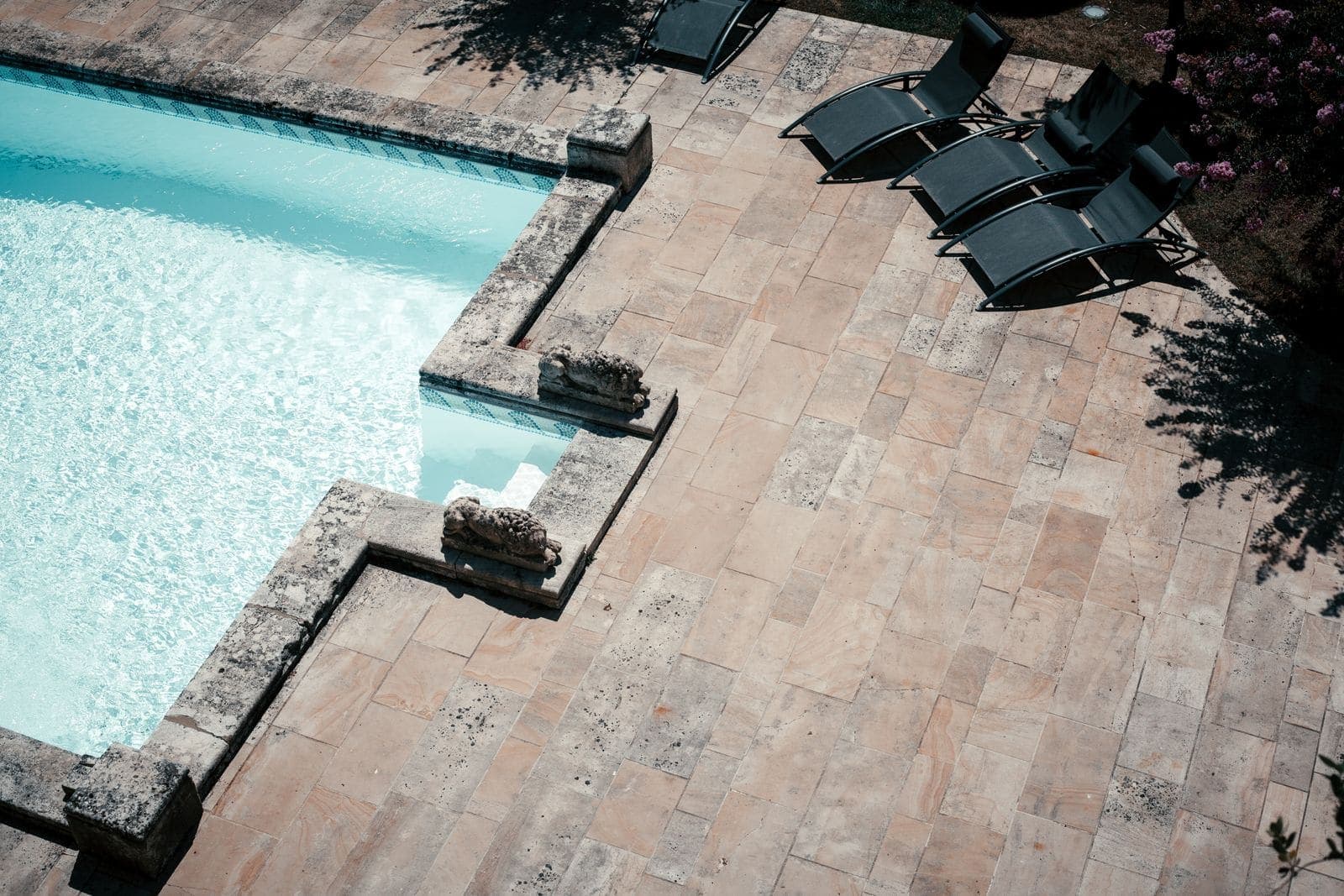
Travertine paver pool deck with lounge chairs at the edge of the water
  • Licensed, insured builders

    Your pool is built by a licensed Florida pool builder you can look up

  • Fixed line-item pricing

    A fixed price for the scope you approve, priced line by line

  • 3D design first

    See the pool before a shovel touches the yard

  • Free on-site estimates

    No obligation

  • One point of contact

    The same person handles your design, your quote, and your questions

A Jacksonville pool deck is usually travertine, concrete pavers, or brushed or stamped concrete, chosen for how hot it gets underfoot in August, how it drains, and how it holds up near a cage and coping. Travertine stays coolest and drains well through its joints, pavers are the common middle choice, and concrete costs the least but cracks more easily as the ground settles. A paver or travertine deck in the Jacksonville area runs about $14 to $30 per square foot installed in 2026, or roughly $10,000 to $30,000 for a typical 600 to 1,000 square foot deck.

Travertine, pavers, or concrete: which deck material fits?

Travertine is a natural stone with a porous surface that stays noticeably cooler than concrete in direct sun, often 20 to 30 degrees cooler on a hot afternoon, which matters on a deck you walk across barefoot in August. It costs the most of the three and resists staining well once sealed.

Concrete pavers are the deck material we spec most often in Nocatee, St. Johns, and Fleming Island. They cost less than travertine, come in enough colors to match most homes, and individual pavers can be lifted and reset if the base settles.

Brushed or stamped concrete costs the least up front. Brushed concrete with a light broom texture is an economical choice for a simple deck. Stamped concrete mimics stone or tile but needs a sealer Florida sun breaks down fast, often resealed every year or two. Cool deck coatings are a thin topping applied over existing concrete to lower surface temperature and refresh a worn deck without a full tear-out.

How much heat and slip resistance do you actually need?

Surface temperature and slip resistance both come down to texture and color as much as material. Lighter colors reflect more heat than dark ones in any material, and travertine's natural porosity dissipates heat better than dense poured concrete. Brushed or tumbled finishes on both travertine and pavers give better grip when wet than a smooth, polished surface, which matters most right at the pool edge and around steps.

Stamped concrete can be textured for slip resistance too, but that texture depends on the sealer holding up, and a worn coat gets slicker over time until it is reapplied.

How does the deck drain away from the house?

Every pool deck is sloped away from the house and toward a drain, swale, or landscaped area, never toward the foundation. In Jacksonville's sandy, flat terrain that slope has to be set carefully, since there is often not much natural fall to work with, and standing water can undermine a sand base over time if drainage is not planned correctly.

HOAs in many planned communities, including Nocatee, review drainage plans for pool decks specifically. We design the slope and any drain inlets as part of the deck layout, not as an afterthought once the concrete or pavers are down.

Sand-set or mortar-set: which base works near a cage?

Pavers are typically sand-set on a compacted base with polymeric sand in the joints, which lets the deck flex slightly with ground movement without cracking, a real advantage on sandy soil. Mortar-set installations bond pavers rigidly to a concrete base and are more common where the deck ties into a screen enclosure's anchored slab, since the cage anchors need a stable surface to bolt into.

Edge restraint matters more with sand-set pavers, since rigid edging around the perimeter and against the coping keeps the field from spreading over time, especially near cage anchor points.

Do pool decks need sealing and expansion joints?

Travertine and pavers both benefit from sealing, which locks in joint sand and resists staining from suntan oil and leaves. Stamped and brushed concrete need sealing to hold color and slip resistance, and that sealer wears out faster under Florida UV.

Poured concrete decks need expansion joints cut at regular intervals so the slab can move without cracking randomly. Pavers do not need cut joints since the individual units and sand joints absorb that movement on their own, one reason pavers hold up well on shifting Jacksonville soil.

How does the deck integrate with the coping, and what gets inspected?

Coping is the cap piece that finishes the pool edge where it meets the deck, and its material and color are usually chosen to complement or contrast the deck field. A travertine deck commonly pairs with matching travertine coping, while a paver deck often pairs with a precast concrete coping in a coordinating tone.

A new or replaced deck also ties into the equipotential bonding grid, the buried copper conductor system that keeps metal around the pool at the same electrical potential, and that bonding must be inspected before the deck concrete is poured. Deck permits are handled by the same jurisdiction that permits the pool itself, and HOA material and drainage approval often applies on top in planned communities.

Do flood zones affect deck elevation?

Lots at the Beaches, Davis Shores, riverfront Riverside, and Amelia Island can sit in AE or VE flood zones, where elevation requirements affect the deck, equipment pad, and enclosure footings. We do not guess at elevation numbers, since they depend on the parcel's flood zone and base flood elevation, and we coordinate with the local floodplain office where a lot falls in one of these zones.

What does a pool deck cost in Jacksonville?

These are 2026 estimates for the Jacksonville area, priced per square foot installed since deck size varies so much by lot and pool shape.

2026 Jacksonville area estimates
ScopeTypical rangeWhat drives it
Paver or travertine deck$14 to $30 per sq ftMaterial, pattern, base prep
Typical 600 to 1,000 sq ft deck$10,000 to $30,000Size, material choice, drainage
Brushed or stamped concrete deckBelow the paver and travertine rangeFinish, sealer, color
Cool deck coating over existing concreteBelow a full replacementExisting slab condition, coverage area

Want the numbers before you call?

Read the 2026 Jacksonville cost ranges, then decide what you want to ask us about.

The process

How a pool deck project runs

  1. 01

    Estimate

    We walk the yard, check access, grade, and setbacks, and talk through what you want. Free, and usually under an hour.

  2. 02

    3D design

    You see the pool, deck, and enclosure together in 3D before anything is dug. Shape, finish, lighting, all of it.

  3. 03

    Fixed quote

    A line-item quote. Shell, plumbing, equipment, finish, coping, deck, and cage each priced on their own line.

  4. 04

    Build

    A licensed Florida pool builder takes it from here, pulls the permit, and builds to the approved design.

  5. 05

    Walkthrough

    Once it passes final inspection you walk the finished pool with your builder, get the warranties, and learn how to run the equipment.

FAQ

Questions homeowners ask us

Free estimate

Get a fixed quote for your pool deck

Pick a day that works. We confirm the time, walk the yard with you, and follow up with a 3D design and a fixed line-item quote.

  • Licensed, insured builders. Your pool is built by a licensed Florida pool builder you can look up.
  • Fixed line-item pricing. A fixed price for the scope you approve, priced line by line.
  • 3D design first. See the pool before a shovel touches the yard.
  • Free on-site estimates. No obligation.
  • One point of contact. The same person handles your design, your quote, and your questions.
CallGet Quote