
Skip to content
HN Pool ConstructionJacksonville, FL

Pool Screen Enclosures

Pool Screen Enclosures in Jacksonville

Aluminum pool cages engineered for your address, with the mesh, roof style, and doors matched to how you use the pool.

Mon-Fri 8am-9pm, Sat-Sun closed. We answer the phone.

Mansard style aluminium screen enclosure over a pool and paver deck
  • Licensed, insured builders

    Your pool is built by a licensed Florida pool builder you can look up

  • Fixed line-item pricing

    A fixed price for the scope you approve, priced line by line

  • 3D design first

    See the pool before a shovel touches the yard

  • Free on-site estimates

    No obligation

  • One point of contact

    The same person handles your design, your quote, and your questions

A pool screen enclosure in Jacksonville is an aluminum frame with screen walls and roof, engineered to the Florida Building Code wind speed for your address. It keeps out bugs, leaves, and oak pollen, cuts direct sun, and a self-closing, self-latching door can meet the Chapter 515 safety requirement. In 2026 a standard cage runs about $18 to $35 per square foot, or roughly $18,000 to $45,000 for a typical 800 to 1,500 square foot enclosure.

Why do most Northeast Florida pools have a screen cage?

A screen enclosure earns its keep here for reasons that have nothing to do with looks. It keeps love bugs, mosquitoes, and no-see-ums off the pool and deck, keeps falling leaves and oak pollen out of the filter, and cuts down on the sun and heat of an uncovered deck in summer.

It also does double duty as a safety layer. Under Chapter 515, a new residential pool needs at least one approved safety feature before final inspection, and a cage with self-closing, self-latching doors on every opening from the house is one of the most common ways homeowners meet that requirement.
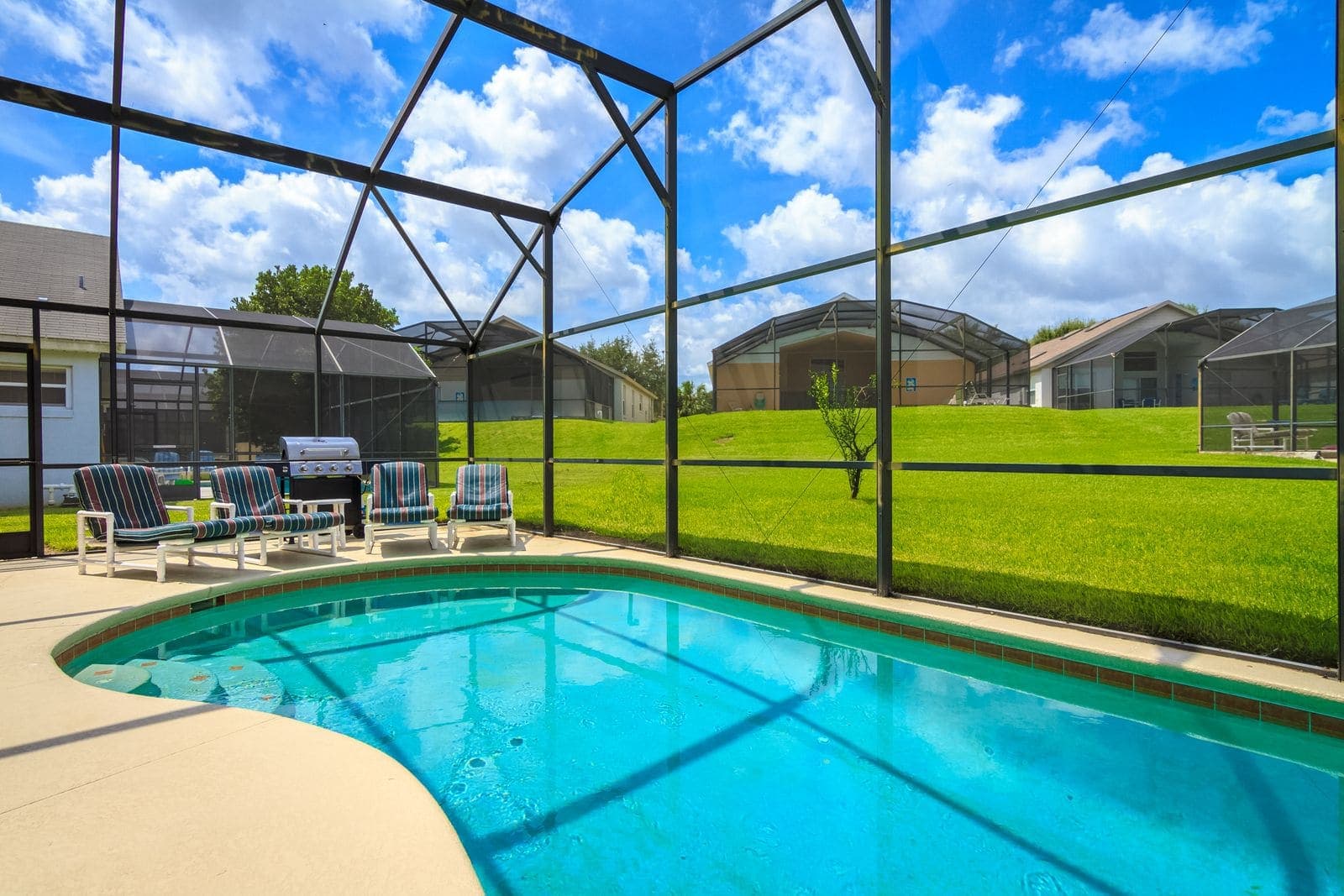
Mansard, gable, or dome: which roof style fits your yard?

A mansard roof slopes up from the walls to a flat or low-pitched center section, giving the most usable height in the middle, and is the most common style over a pool and deck. A gable roof runs to a center ridge like a house roof and works well on rectangular footprints or where the cage attaches to the roofline.

A dome roof curves continuously from wall to peak with no flat sections, shedding water and debris well, though it costs more to engineer. The right style depends on your roofline, pool shape, and how tall you want the cage.

What screen types are available?

Standard 18x14 fiberglass mesh is the baseline screen used on most cages, blocking the insects that matter here and holding up well.

  • 18x14 fiberglass, the standard choice for most of the cage
  • 20x20 no-see-um mesh, a finer weave for lots near water
  • Super screen, a heavier weave that resists tears and UV breakdown
  • Pet screen, a coated mesh that resists scratching from dogs
  • Clear-view picture window panels, larger spans with fewer verticals for an open view

Powder coat and marine-grade finish near the coast

Every frame gets a powder coat finish for color and corrosion resistance, but within a few miles of the ocean or Intracoastal, salt spray accelerates wear on standard hardware. For lots at the Beaches, Ponte Vedra, and similar coastal areas we specify marine-grade powder coating and 316 stainless fasteners, since salt exposure drops off sharply only after a few thousand feet from the shoreline.

How is a pool cage engineered for Jacksonville wind?

Northeast Florida builds under the 2023 Florida Building Code, which adopts ASCE 7-22 wind provisions. Ultimate design wind speeds across Duval, St. Johns, Clay, and Nassau counties run roughly 120 to 140 mph depending on distance from the coast, with the Beaches, Ponte Vedra, and Amelia Island at the higher end. A cage is sized to the wind speed and exposure at your specific address, not a generic catalog structure.

That engineering covers beam and column sizing, corner bracing, and anchor spacing into the deck, backed by signed and sealed engineering. Aluminum framing and screen systems carry Florida Product Approval, the statewide system that applies outside the Miami-Dade Hurricane Zone, which does not reach Jacksonville. Removable panels require a decal noting the wind speed above which they must come down.

How are the screens anchored, and what makes a door meet the safety rule?

The frame is anchored into the deck at engineered spacing, using embedded anchors set when the deck is poured or expansion anchors drilled into existing concrete. A retrofit cage on an older deck gets checked for concrete condition first.

For a screen enclosure to serve as the Chapter 515 barrier, every door between the house and pool needs a self-closing, self-latching mechanism, with the release positioned so a small child cannot easily reach it. This is one of several ways to meet the safety act, alongside a fence, an approved cover, exit alarms, or a certified pool alarm.

Do you need a permit for a pool cage?

Yes, a screen enclosure is its own permit separate from the pool permit in every jurisdiction here. Jacksonville Building Inspection Division handles Duval outside the beach cities, which run their own departments. St. Johns County covers Ponte Vedra Beach, Nocatee, St. Johns, and Julington Creek, with St. Augustine permitting separately. Clay County covers Fleming Island and Middleburg, with Orange Park permitting on its own. Nassau County covers unincorporated Amelia Island, with Fernandina Beach permitting inside city limits.

HOA and architectural review committees in Nocatee, Julington Creek Plantation, and gated Ponte Vedra neighborhoods commonly require approval of cage design, height, and frame color before the permit goes in, so we prepare both submittals together where that applies.

What does a screen enclosure cost in Jacksonville?

These are 2026 estimates for the Jacksonville area, priced by square footage of the footprint.

2026 Jacksonville area estimates
ScopeTypical rangeWhat drives it
Standard mansard or gable cage$18 to $35 per sq ftFootprint, wind zone, roof style
Typical 800 to 1,500 sq ft enclosure$18,000 to $45,000Size, mesh type, doors
Super screen, picture-window panels, or taller cagesAbove standard rangeUpgraded screen and larger open spans

How long does a screen enclosure take to build?

Engineering and permitting typically run several weeks depending on the jurisdiction and whether HOA review applies. Building the frame and screen on an average residential cage usually takes one to two weeks once permitted, weather permitting. Rescreening or repair after storm damage is faster, often a day or two.

Want the numbers before you call?

Read the 2026 Jacksonville cost ranges, then decide what you want to ask us about.

Gallery

Pool Screen Enclosures work

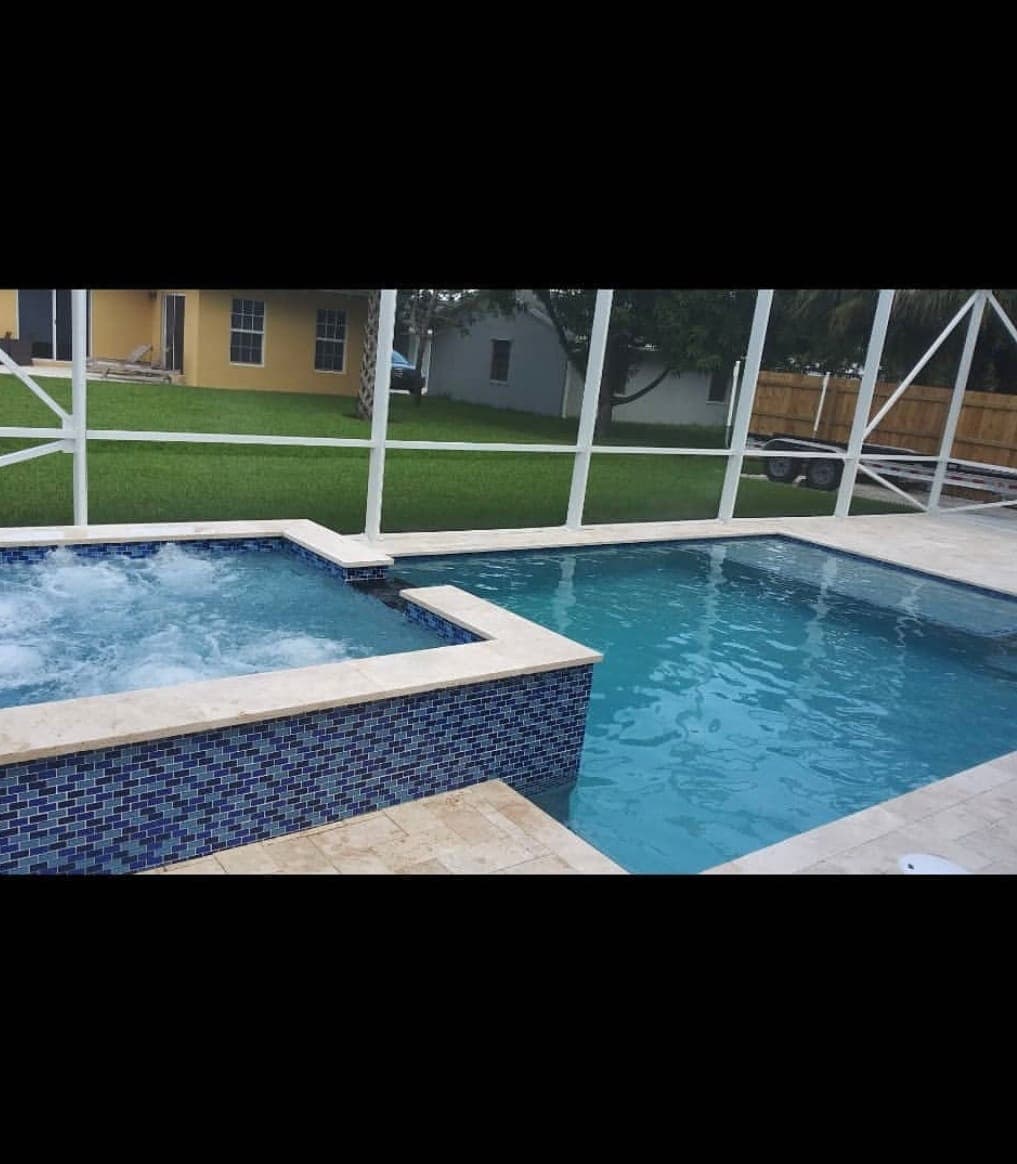
  • Pool and raised spa finished in blue glass tile, with a travertine deck under a white aluminum screen enclosure

    Screened pool and raised spa

    St. Johns, FL

The process

How a screen enclosure project runs

  1. 01

    Estimate

    We walk the yard, check access, grade, and setbacks, and talk through what you want. Free, and usually under an hour.

  2. 02

    3D design

    You see the pool, deck, and enclosure together in 3D before anything is dug. Shape, finish, lighting, all of it.

  3. 03

    Fixed quote

    A line-item quote. Shell, plumbing, equipment, finish, coping, deck, and cage each priced on their own line.

  4. 04

    Build

    A licensed Florida pool builder takes it from here, pulls the permit, and builds to the approved design.

  5. 05

    Walkthrough

    Once it passes final inspection you walk the finished pool with your builder, get the warranties, and learn how to run the equipment.

FAQ

Questions homeowners ask us

Free estimate

Get a fixed quote for your screen enclosure

Pick a day that works. We confirm the time, walk the yard with you, and follow up with a 3D design and a fixed line-item quote.

  • Licensed, insured builders. Your pool is built by a licensed Florida pool builder you can look up.
  • Fixed line-item pricing. A fixed price for the scope you approve, priced line by line.
  • 3D design first. See the pool before a shovel touches the yard.
  • Free on-site estimates. No obligation.
  • One point of contact. The same person handles your design, your quote, and your questions.
CallGet Quote